The Complete LDS Wedding Invitation Guide: Wording, Etiquette, Timing, and Everything Your Mom Forgot to Mention
A real guide for Latter-day Saint brides planning a temple sealing, a ring ceremony, an open house, or all three at once.
If you have been Pinterest-deep in wedding invitations for the last week and walked away feeling more confused than when you started, this is for you.
Here is the thing nobody tells you when you start designing your invitations. You are not just announcing a wedding. You are coordinating a sealing, sometimes a ring ceremony, a reception or an open house (or both, if family is spread between Texas and Idaho), a luncheon, a dress code conversation, and the gentle navigation of which guests can attend which part of the day. Most invitation advice on the internet does not account for any of that. Which is why so many brides end up with a stack of beautiful invitations that do not actually communicate what they need to communicate.
We have been designing invitations for Latter-day Saint brides for eighteen years, and we have seen every version of the LDS wedding suite there is. Brides being sealed at the Salt Lake Temple with a ring ceremony in Park City. A couple flying home to Houston for an open house two weeks after their Manhattan Temple sealing. A bride from Atlanta whose mother insisted on three separate open houses across three different states (we made it work). We have shipped invitations to brides in Seattle, Nashville, San Diego, Washington DC, Boston, Phoenix, Raleigh, Denver, Sacramento, Orlando. The geography changes. The questions are almost always the same.
So let's get you through them. Pour something warm. Take your time. We will get you there.
The Quick Version
If you are skimming because you have a vendor meeting in twenty minutes, here is the short version of what you need to know:
LDS weddings often require a layered invitation suite, not a single card: a main invitation, a sealing insert for the close circle, and reception or open house details that go to everyone.
The sealing details typically go on a separate insert card, not on the main invitation. Sealings are sacred and intimate, and most of the people receiving your invitation are not invited into the sealing room itself.
If you are hosting both a reception and an open house, list them both on the invitation and let your guests self-select which one they will attend. Most do.
Mail invitations 6 to 8 weeks before your wedding for local guests, and 8 to 10 weeks for guests traveling in or for weddings near major holidays.
Reception and open house are not the same thing in LDS culture, and the wording on your invitation needs to match which you are hosting (or both).
Plan for about one invitation per household, not per person, plus 10 to 15 percent buffer.
Now the rest of it...
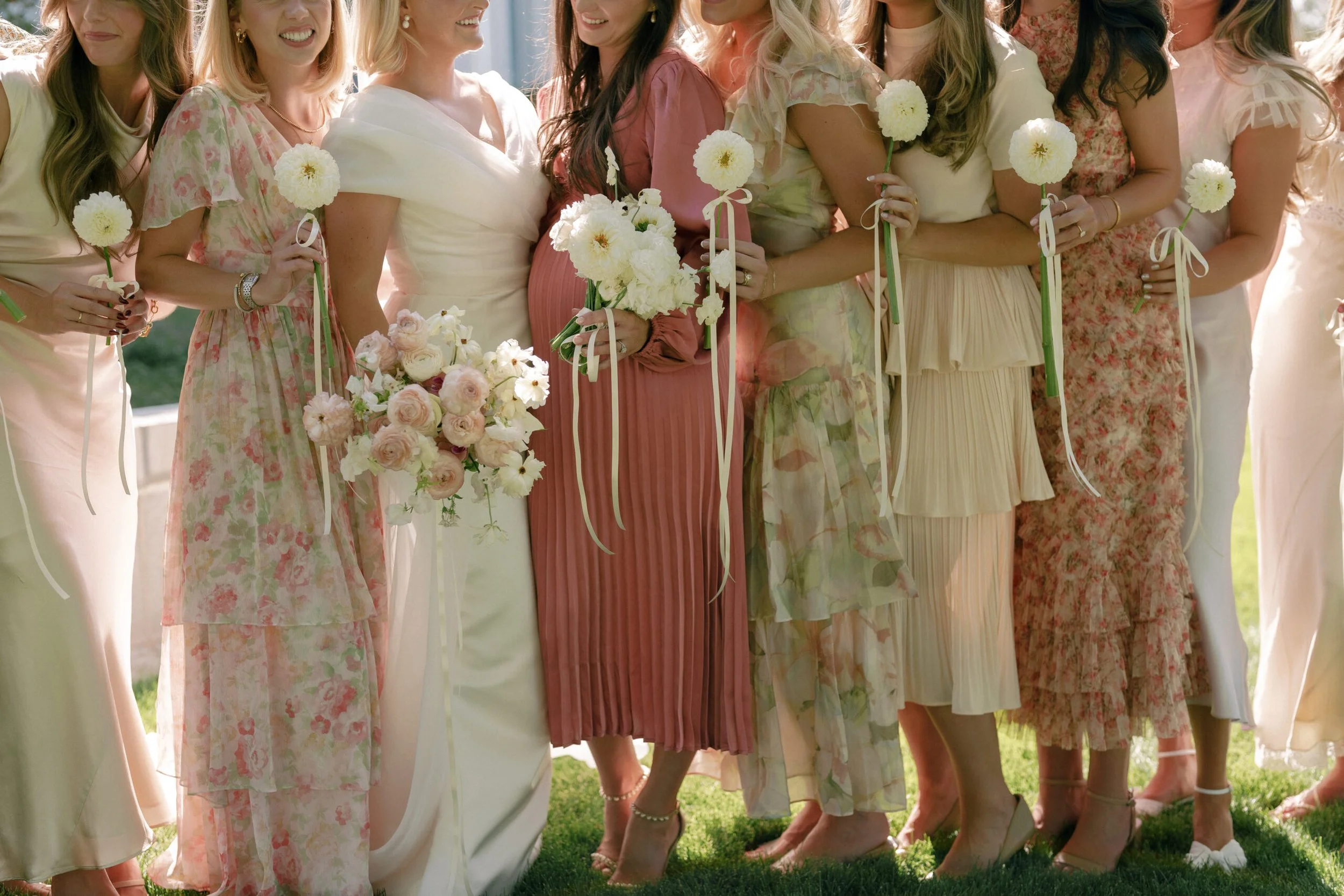
image by Ashley Teresa
How an LDS Wedding Invitation Suite Works
A non-LDS wedding invitation is usually a single invitation with a reception detail tacked on the back, plus an RSVP. That is not the structure that serves you here. Your day has more parts than that, and your invitation has to accommodate them.
A typical LDS invitation suite includes the following pieces, though you do not need every single one:
The main invitation. This is the piece that goes to every guest on your list. It announces the marriage, includes the names of the couple, the temple (or a "sealed for time and all eternity" reference), the date, and the location for the reception or open house. If you are hosting both a reception and an open house, the main invitation lists both events and trusts your guests to choose which one they will attend.
A sealing insert card. This goes only into the envelopes of guests invited to the sealing itself. It includes the sealing time, the temple, and a polite note about temple recommend requirements. Some brides include a separate RSVP for the sealing so they can confirm exactly who plans to attend and adjust if there are open seats in the sealing room.
A ring ceremony insert. If you are having a ring ceremony for the friends and family who cannot attend the sealing, this insert tells them where, when, and how to dress. We will say more about ring ceremonies in a minute, because they have become one of the most meaningful parts of the day for couples whose families are mixed.
An RSVP card. Optional but recommended if you are doing a sit-down dinner, a luncheon, or a reception with a strict head count.
A details or "what to expect" insert. Especially helpful when a meaningful portion of your guest list has never been to an LDS wedding. This is where you can warmly explain the temple sealing, the dress code, parking, hotel blocks, or anything else that would otherwise create a flurry of texts to your bridesmaids the week of the wedding.
A simple sealing-and-reception wedding might only need a main invitation and a sealing insert. A more involved wedding with a luncheon, two open houses in different cities, and a ring ceremony might need every piece on this list. The right suite depends on what your day actually looks like, and one of the things our team does early in the design process is help you map out which pieces you actually need (and which you can skip without losing any clarity).
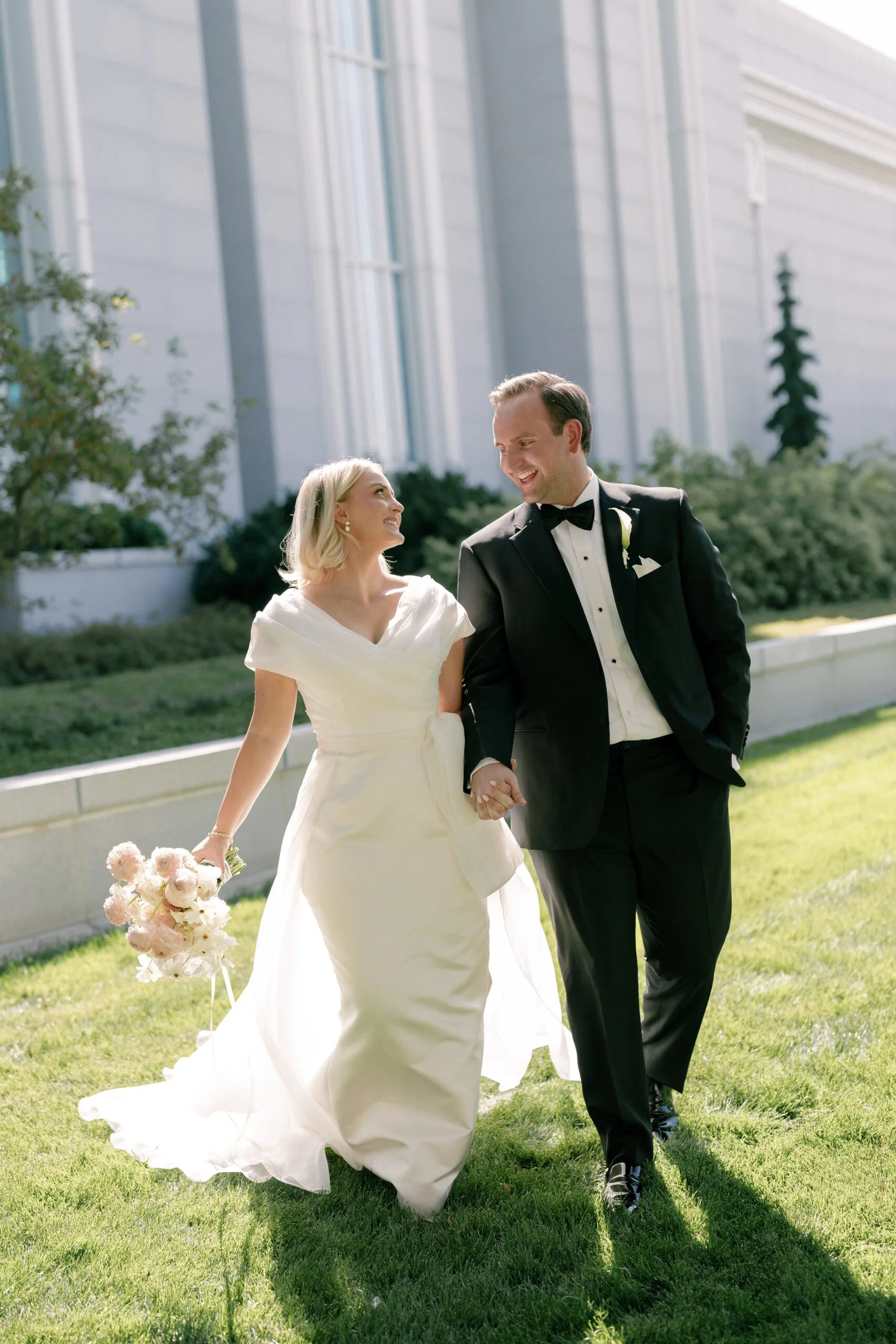
image by Ashley Teresa Gown: Penelope Perkins Floral: Terra Flora Designs
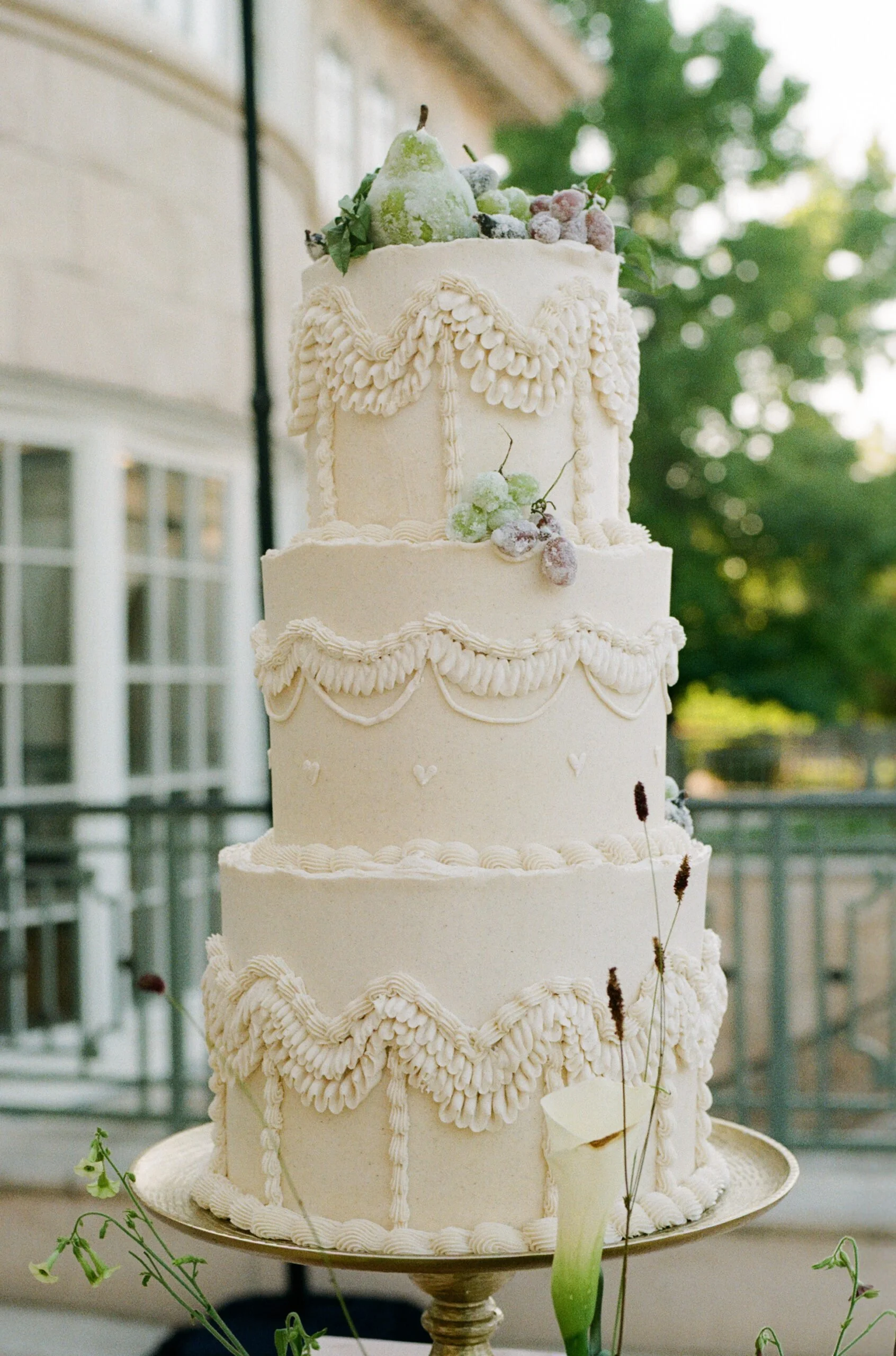
image by Ashley Teresa Floral: Terra Flora Designs Cake: Quinton Kitchen
LDS Wedding Invitation Wording: Real Examples That Sound Like You
Wording is the part most brides get stuck on. Either the templates online sound like they were written in 1962, or they read like a Pinterest reel and lose all the warmth. The goal is wording that sounds like you and your family, while still doing the etiquette work an invitation is supposed to do.
We had a bride a couple of years back, planning a sealing at the Washington DC Temple with a reception in Northern Virginia. She came to us with a wording draft her grandmother had written in full Victorian formality (every name spelled out, "the honor of your presence is most respectfully requested," the works) and the bride almost sent it. The invitation was beautiful. It just did not sound anything like her. We rewrote it together over the course of two phone calls, kept the elegance, lost the stiffness. Her grandmother told her it was the loveliest invitation she had ever received. The lesson: traditional and warm are not opposites. You can absolutely have both.
A few notes before the examples:
You do not have to use "the honor of your presence is requested" if it does not feel like you. That phrasing is traditional, beautiful, and still very common, but "joyfully invite," "are pleased to share," and "together with their families" are all just as appropriate.
Spell out the date and time for formal invitations ("Saturday, the sixth of June, two thousand twenty-six, at eleven o'clock in the morning"). Use numerals for casual or modern invitations.
Temple names are universally recognized inside the LDS community. You do not need to include the temple address.
The phrase "sealed for time and all eternity" is the standard language for a temple sealing. You can also use "joined in marriage and sealed," "married and sealed," or simply "sealed."
If your parents are hosting in the traditional sense, their names go at the top. If you and your fiancé are hosting yourselves, "Together with their families" is a graceful way to honor parents without putting their names in the host line.
Wording Example One: Traditional and Formal
“Together with their families
Hannah Marie Whitaker
and
Caleb Joseph Hartley
request the honor of your presence at a reception celebrating their marriage
Saturday, the sixth of June two thousand twenty-six at six o’clock in the evening
The Manor House Provo, Utah”
(With a separate sealing insert noting the temple and time for those invited to the sealing.)
Wording Example Two: Modern and Warm
“Hannah & Caleb
joyfully invite you to celebrate their marriage as they are sealed for time and all eternity
June 6, 2026 | The Manhattan New York Temple
A reception will follow that evening Details enclosed”
This version puts the sealing on the main invitation, which works beautifully when most of your guest list is already familiar with LDS weddings and the sealing is a meaningful part of the day you want acknowledged. If you have a guest list that skews mostly non-member, the more traditional version above tends to land better.
Wording Example Three: Sealing Insert (Goes Only to Sealing Guests)
“We would be honored to have you with us as we are sealed for time and all eternity
Saturday, June 6, 2026 at 11:00 AM Houston Texas Temple
A current temple recommend is required for entry.Please plan to arrive thirty minutes early.
Kindly RSVP by May 15”
That last line about the recommend is the gentle, etiquette-correct way to communicate the requirement without it feeling like a velvet rope. Most LDS guests already know, but the line ensures everyone has the information without anyone having to ask.
Wording Example Four: Ring Ceremony Insert
“Following the temple sealing, please join us for a ring ceremony
Saturday, June 6, 2026 | 4:00 PM The Manor House Garden
A reception will follow”
A ring ceremony invitation is brief by design. The point is to gather everyone, exchange rings publicly, share a few words, and roll into the celebration. This insert can also be combined with the reception insert if the events flow back-to-back at the same venue.
Wording Example Five: Reception and Open House on the Same Invitation
“Hannah Whitaker and Caleb Hartley
were sealed for time and all eternity on Saturday, June 6, 2026 in the Atlanta Georgia Temple
You are warmly invited to celebrate with us
Reception Saturday, June 6 | 6:00 to 8:00 PM The Estate at Cherokee Dock
Open House Saturday, June 13 | 2:00 to 4:00 PM The Hartley Home 482 South Maple, Mesa, Arizona”
This is the most common way to handle a "both" situation. Both events on the invitation, dress code or RSVP cues for each, and your guests choose. We had one bride from Phoenix whose Texas family came to the Mesa open house, while her husband's California family came to the Arizona reception. Same invitation, no awkwardness. Most LDS guests know how to read this format and will pick whichever event makes the most sense for them geographically and logistically.
Wording Example Six: Two Open Houses, Different States
“Hannah Whitaker and Caleb Hartley
were sealed for time and all eternity on Saturday, June 6, 2026 in the Nashville Tennessee Temple
You are warmly invited to celebrate with us
Open House — Tennessee Saturday, June 6 | 6:00 to 8:00 PM The Hartley Home, Brentwood
Open House — Idaho Saturday, June 20 | 2:00 to 4:00 PM Whitaker Family Backyard, Rexburg”
When family is split between two states (a common reality for couples who met at college and have parents on opposite ends of the map), two open houses keep everyone celebrated without requiring travel from anyone. The invitation lists both, and guests self-select.
The Sealing Announcement: How to Be Inclusive Without Being Awkward
This is the moment that gets tender for almost every LDS bride, and it is worth slowing down for.
You are being sealed in a temple. Your sealing room holds a limited number of people. Some of the people you love most in the world are not endowed members of the Church and cannot enter the sealing room with you. That includes, for many couples, parents, siblings, grandparents, lifelong friends, in-laws of in-laws.
The invitation is the first point of contact for navigating this. Done well, it makes everyone feel celebrated and included even if they cannot be in the sealing room itself. Done poorly, it can quietly hurt feelings that take years to repair.
We had a bride in Charlotte a few years ago whose draft invitation listed her sealing at the Raleigh North Carolina Temple right at the top, in the largest type, with the reception details in smaller type below. She was so proud of the sealing that she wanted it to be the first thing her guests saw. Which was beautiful and understandable. The problem was that more than half her guest list was not endowed and would not be in the sealing room. We talked it through and ended up moving the sealing to a small insert card that went only to the sealing guests. The main invitation led with the reception, which was the part of the day everyone was invited to. Her grandmother (Methodist, in her words "very Southern, very traditional") told her later it was the most thoughtful invitation she had received in fifty years. Sometimes love means putting the focus on the part of the celebration your guests can share.
A few principles that help:
Do not list the sealing on the main invitation when the majority of your guest list is not invited to it. This is the single most important wording decision you will make. Putting the sealing on a separate insert, sent only to those invited, keeps the main invitation focused on the celebration everyone can attend.
Use the ring ceremony to include non-temple-recommend family. A ring ceremony is short, simple, and meaningful. It gives parents who are not endowed, non-member friends, and extended family something to attend that feels ceremonial without crossing into territory the Church reserves for the temple. We have written invitations for hundreds of ring ceremonies, and the brides who plan one almost always tell us afterward that it was the part of the day their family talked about most. One bride in Boston told us her father (not a member) cried more during her ring ceremony than she did. Her words: "It was the moment he got to be my dad on my wedding day."
Consider including a brief explanation insert for non-member guests. If a meaningful portion of your guest list has never been to an LDS wedding, a short, warm insert (or a note on your wedding website) explaining the temple sealing and why the reception is the celebration they are invited to can prevent a lot of confusion. Something like:
A note for our guests: Our marriage will be sealed in an LDS temple, which is a sacred space reserved for endowed members of the Church. We know this is different from many wedding traditions, and we want you to know how much your presence at our reception means to us. The reception is our celebration with everyone we love, and we cannot wait to be there with you.
That paragraph, delivered warmly, prevents about ninety percent of the awkward day-of conversations that catch couples off guard.
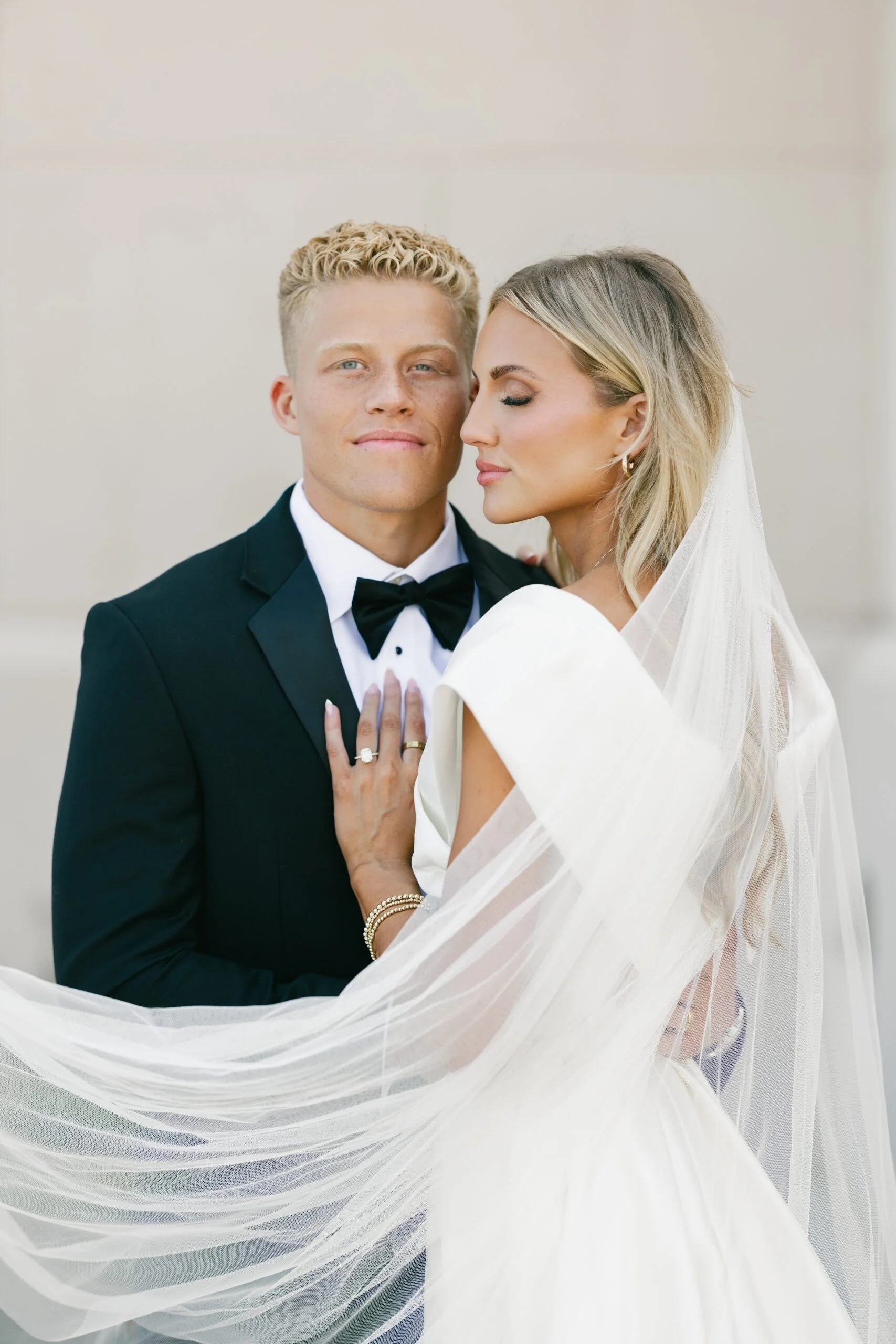
Photographer: Jenessa Fuller Photography LLC Associate Photographer: Ciaran Mae Photo Planner: Maddie Keysor Gown: Alta Moda Bridal
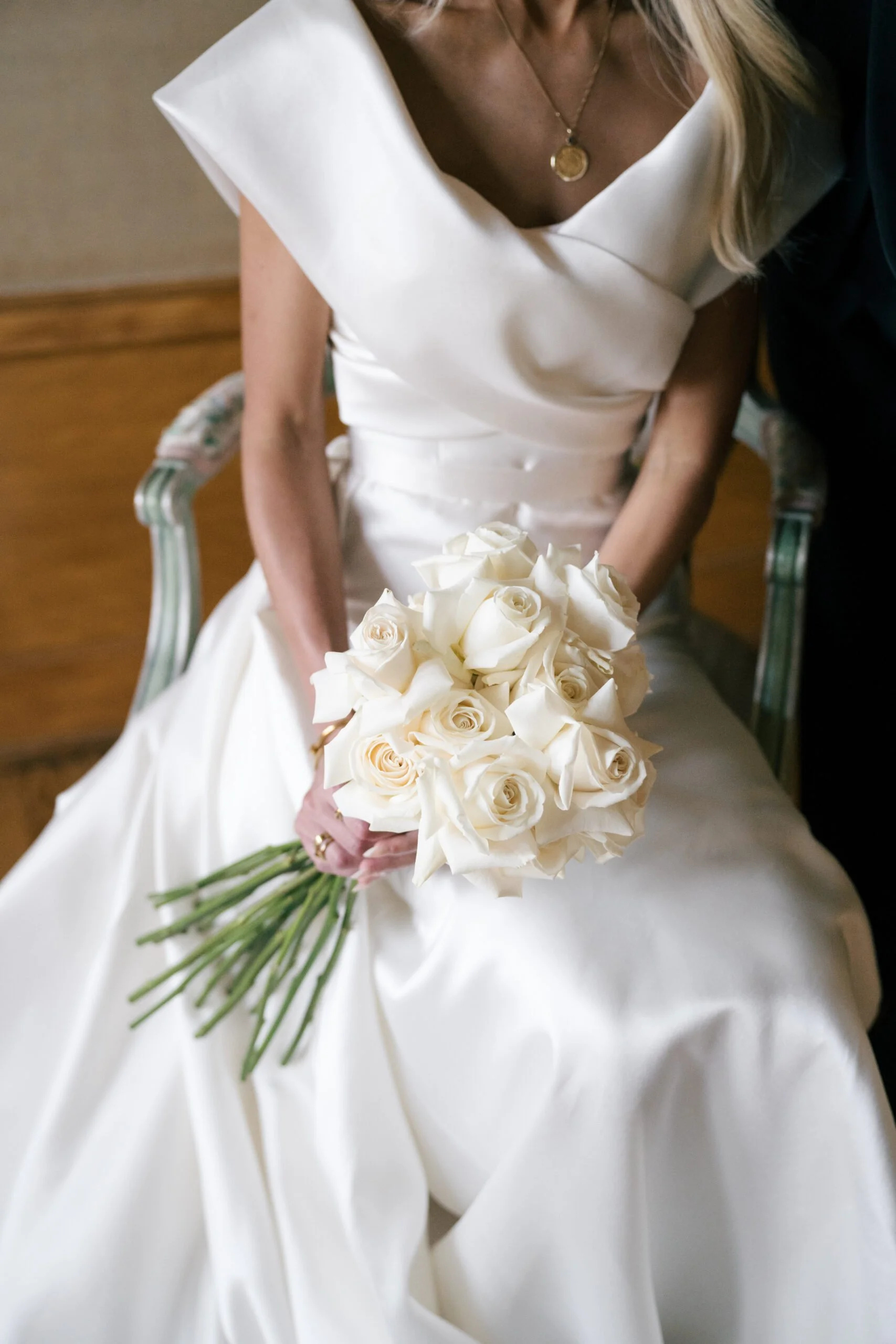
Photographer: Jenessa Fuller Photography LLC Associate Photographer: Ciaran Mae Photo Planner: Maddie Keysor Gown: Alta Moda Bridal
Reception vs. Open House: The Difference (And Why It Matters on Your Invitation)
A lot of LDS brides use these terms interchangeably. Most non-LDS guests do not know they are different things at all. Knowing the difference helps you word your invitation correctly and helps your guests show up with the right expectations.
A reception is a more structured event. It usually has a defined start time, a program (first dance, cake cutting, toasts, sometimes dinner or heavy hors d'oeuvres), and an end time. Guests are expected to stay for the duration, or at least most of it. Receptions are often dressier, more formal, and more like the wedding reception your non-member friends are picturing when they hear the word "reception."
An open house is a flowing, come-and-go celebration. There is no formal program. Guests stop in any time during the open window, congratulate the couple in a brief receiving line, enjoy refreshments, take a photo, and continue with their evening. Open houses tend to last two to three hours, are less formal in tone, and are designed to accommodate a much larger guest list because not everyone is there at the same time.
True story: we worked with a couple in Sacramento who hosted an open house from 6 to 9 PM. The bride's grandmother arrived at 6:02, stayed until 8:45, and held court in the corner with a slice of cake and a never-empty glass of sparkling cider. Her words on the way out: "I came for ten minutes. I stayed for three hours. That is the sign of a good open house." (She is correct.)
Many LDS couples host both a reception and an open house. A smaller, more formal reception with the closest circle (often with a sit-down dinner or a luncheon earlier in the day), followed by a separate open house for the broader community of friends, ward members, and extended family. When you are hosting both, you list both on the invitation, and your guests choose which one they will attend based on how close they are to you. Some guests will come to both. Most pick one. The wording should make clear which event is which, with simple labels like "Reception" and "Open House" and clear time windows for each.
Inserts: What Goes on Them and What Does Not
Inserts are the workhorses of an LDS invitation suite. They do all the logistical heavy lifting, which keeps the main invitation focused, beautiful, and uncluttered.
Here is what typically belongs on inserts:
Sealing details (time, temple, recommend requirement, RSVP)
Ring ceremony details (location, time, dress code if specific)
Additional reception or open house details if the main invitation is getting too crowded
Luncheon or dinner details (sit-down meals always need an RSVP, and the RSVP belongs with this insert)
RSVP cards (with a return address, a date, and a stamp if you can afford it)
Map and directions (especially helpful for out-of-town guests, rural venues, or anywhere with tricky parking)
Wedding website URL (the tidiest place for registry, dress code expansions, hotel blocks, and FAQ)
A "what to expect" note for non-member guests
Things that do not belong on the main invitation, but can go on an insert or your website:
Registry information. Strict etiquette says registry information never goes on the invitation itself. Put it on your wedding website and link to the website on a small enclosure card.
Dress code. A simple "semi-formal attire" line is fine on the reception insert. Long explanations belong on the website.
"No children" or "adults only" requests. Address envelopes carefully (only list the names of the people invited), and if needed, add a discreet note on the RSVP card. Never put "no children" on the main invitation.
Detailed temple etiquette. The temple is sacred, and a paragraph on the invitation explaining what the sealing entails can feel out of place. Save those conversations for in-person or your website.
Timing: When to Send Every Piece
There is a real cost to sending invitations too late, and a smaller (but real) cost to sending them too early. Sent too late, your guests cannot make travel arrangements or commit to your date, and your RSVPs come in past your caterer's deadline. Sent too early, they get filed in a drawer and forgotten.
Here is the rhythm we recommend after eighteen years of watching invitations land:
Save the dates: 6 to 8 months before the wedding. Especially important for destination weddings, holiday weekends, and out-of-state guests who need to book travel. Optional, but they make a meaningful difference for guests who are coordinating flights or asking for time off work.
Main invitations: 6 to 8 weeks before the wedding for most local weddings. Closer to 8 to 10 weeks if you are sending to out-of-state guests, hosting near a major holiday, or asking guests to travel.
RSVP deadline: 2 to 3 weeks before the wedding. Work backward from your caterer's final headcount deadline. If your caterer needs the count two weeks before the wedding, your RSVP deadline should be at least three weeks out, so you have a buffer to chase down the inevitable late responses.
Order your invitations: 8 to 12 weeks before you plan to mail them. Custom design takes time. Letterpress and foil printing take longer than flat printing. Add buffer for proofs, revisions, and any paper sourcing for specialty stocks. If you are inside that window, semi-custom templates are designed exactly for tighter timelines and can ship in as little as two to three weeks.
A common mistake we see: brides who plan to "do invitations later" and then realize, with eight weeks to go, that they need design time, print time, addressing time, and mail time stacked back to back. We had a bride from Orlando email us on a Tuesday in late February asking if we could turn around 180 invitations for her March 15 wedding. We could (and did, on letterpressed cotton, with a deckle edge and foil envelopes — proudest rush job we have ever done), but the bride spent two weeks of her engagement in panic mode that she did not need to spend. The earlier you start, the more options you have, and the more relaxed the process feels.
Guest Count: How to Estimate How Many Invitations to Order
Almost every bride orders too few invitations. Here is the math that prevents that.
You do not order one invitation per guest. You order one invitation per household.
A household is a single mailing address. A married couple is one household. A family with kids is one household. A college roommate going solo is one household. A divorced parent and a remarried parent are two households (you address them separately).
To estimate:
Pull your guest list and group it into households.
Count the households.
Add 10 to 15 percent for buffer (a few addresses you forgot, a few invitations that get damaged in the mail, and one or two to keep as keepsakes).
Order one main invitation per household, plus the inserts you need for each suite.
Most wedding invitation orders end up in the range of 75 to 250 main invitations for a typical LDS reception. Larger open houses or ward-wide invitations push that number higher. If you find yourself ordering more than 300, double-check whether you are mistakenly counting individuals instead of households.
A note on inserts: order the same number of reception or open house inserts as main invitations (everyone gets one), but order fewer sealing inserts (only the close circle invited to the sealing). Same goes for ring ceremony inserts if your ring ceremony is smaller than your reception.
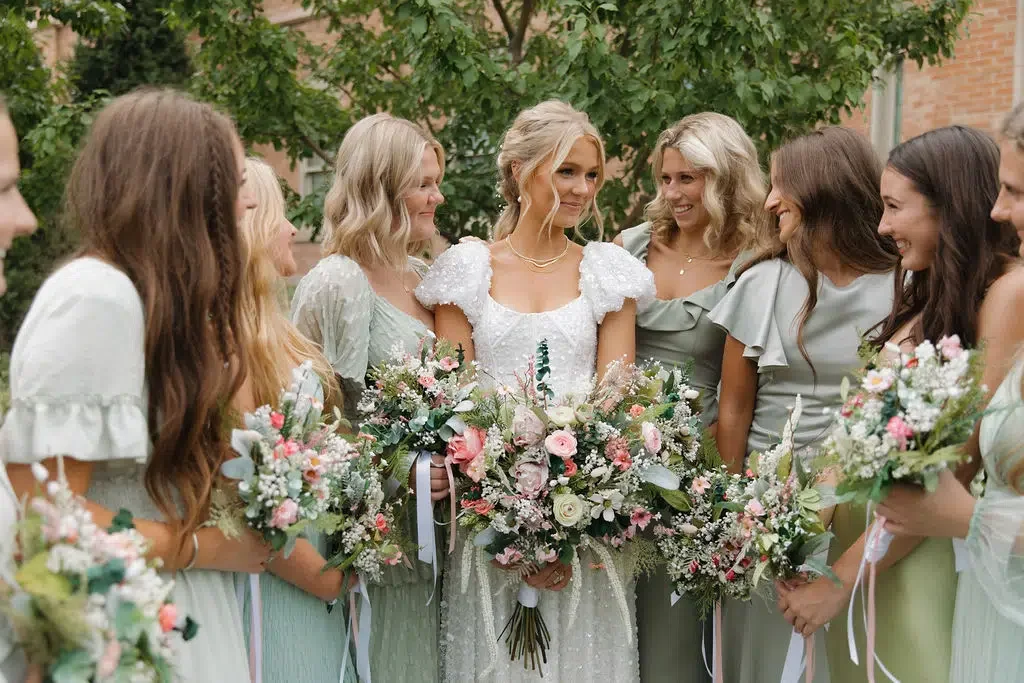
Photography: Sabrina Photo Co.Planning + Catering: Tarren and Company
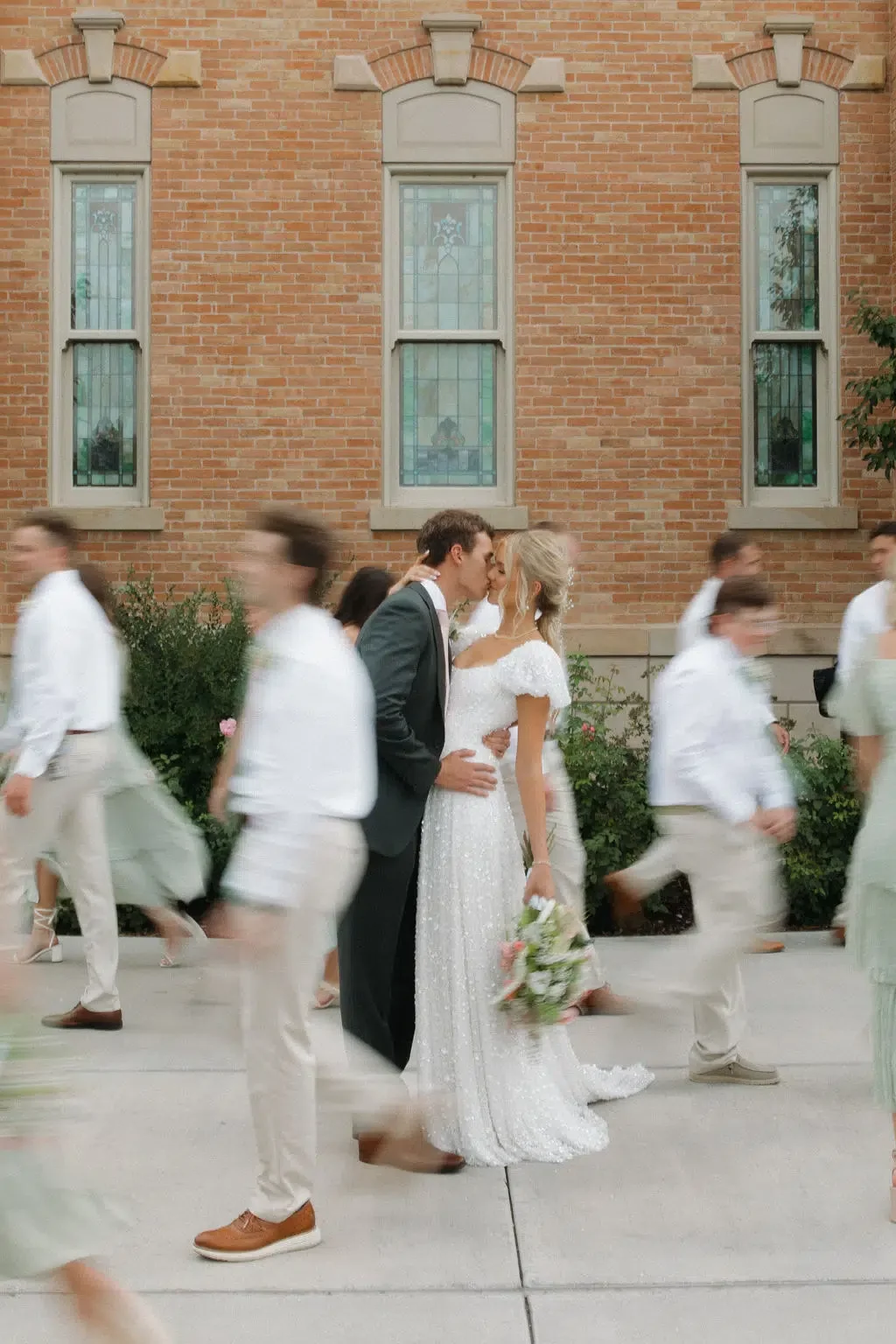
Photography: Sabrina Photo Co.
Frequently Asked Questions
Do I need to include sealing details on every invitation?
No. The sealing details belong on a separate insert that goes only to the guests invited to the sealing. The main invitation focuses on the celebration that includes everyone.
Is it rude to invite someone to the reception but not the sealing?
Not at all. The sealing is a sacred ordinance with limited capacity and specific requirements for attendance. Inviting someone to your reception is inviting them to celebrate with you, and most guests understand and appreciate that distinction. The graceful framing on your invitation, plus a warm explanation insert if needed, makes everyone feel welcome.
How do I handle hosting both a reception and an open house?
List both events on the same invitation with clear labels and time windows. Your guests will self-select which one they attend based on how close they are to you and which one fits their schedule. Some guests will come to both. Most pick one.
Can the bride and groom host their own wedding instead of the parents?
Yes. "Together with their families, [Bride] and [Groom] joyfully invite you" is the most common phrasing for a couple-hosted wedding. It honors parents without putting them in the formal host position.
Do I need to address envelopes by hand?
Hand-addressing or calligraphy is the most beautiful and traditional option. Printed addressing is fine and increasingly common. Avoid stick-on address labels for the main invitation — they tend to look less personal than a printed envelope or a calligraphed one.
What if a family member or friend cannot attend the sealing but wants to be on temple grounds?
Many guests choose to come to the temple to wait outside during the sealing, then join the family for photos on the temple grounds afterward. You can mention this option warmly on the sealing insert or in a follow-up note, so guests who want to be present in some way know they are welcome to be there.
How early should I order invitations?
For custom invitations, 10 to 12 weeks before you plan to mail. For semi-custom templates, 4 to 6 weeks. For tight timelines, ask about rush options before you assume you have run out of time.
Should I include the LDS Church name on the invitation?
If you are listing the temple, you can write "the Atlanta Georgia Temple" or "the Atlanta Georgia Temple of The Church of Jesus Christ of Latter-day Saints." Both are correct. The shorter version is more common and reads more cleanly in formal invitation typography.
What about wedding announcements for people I could not invite?
Send them after the wedding. A photo card with the names, the date, and the temple is plenty. No reception details required.
Can I use the same invitation for guests across different states?
Yes, and most brides do. The invitation goes to everyone, and if you are hosting events in multiple states (a reception in Utah and an open house in Texas, for example), list both. Your guests will attend the one that makes sense for them.


A Final Note on Investment
A custom LDS wedding invitation suite typically falls in the range of $550 to $7,500 depending on the print method, paper, and number of pieces in the suite. Letterpress, foil, deckle (torn) edges, and double-thick cotton paper sit at the higher end. Flat-printed cotton paper with simple inserts sits at the lower end. Semi-custom templates start at a much lower price point and ship faster, which makes them a strong choice when the budget or the timeline calls for it.
Whatever you order, the invitation is the first piece of paper your guests will hold. It sets the tone for the whole day before they ever walk into the reception. Done thoughtfully, it does more than communicate logistics. It tells your guests, gently and beautifully, what kind of day they are about to be part of.
If you want help mapping out which pieces your suite actually needs, our team has been doing this for eighteen years and we can walk you through the whole thing — from sealing insert wording to envelope addressing to mailing schedule. [Request a free consultation here] or [browse our semi-custom LDS templates] if you would rather move quickly.
We would love to be part of your day.